


5 YEARS OF TERROR UNDER THE ANTI-TERROR LAW!
Development and humanitarian workers convened at UCCP Shalom Hotel in Malate, Manila spearheaded by Defend NGOs Alliance and the Council for People’s Development and Governance (CPDG) in order to host a discussion along with human rights and development workers who were victimized by the Anti-Terrorism Act of 2020 five years since its passing.
According to Defend NGOs Alliance, the aforementioned law has remained a primary tool that enables the systemic harassment and criminalization of civil society groups, non-government organizations, and development and humanitarian workers in the Philippines. Supplemented by the Terrorism Financing Prevention and Suppression Act, the coalition exclaims that the repression of the state is enveloped by a legislative architecture that targets human rights defenders and development workers.
This repression, they continued, has prevailed as a systemic pattern of surveillance, red-tagging, asset freezes, and fabricated charges. These symptoms are manifested in the cases of organizations such as Cordillera Peoples Alliance (CPA), Leyte Center for Development (LCDe), Paghida-et sa Kauswagan Development Group (PDG), Community Empowerment Resource Network (CERNET), and Rural Missionaries of the Philippines (RMP).
Joselito Macapobre from PDG - Negros, Atty. Rey Gorgonio from NUPL Negros, Neil Eco from Altermidya, and Dyan Gumanao from Hustisya provided their testimonies in the forum, detailing their experiences as victims of the ATAs intensifying crackdown on dissent. Notably, this repression is most pronounced in the Vizayas region with documented cases that rose to international prominence from the conviction of Tacloban-based journalist Frenchie Mae Cumpio and lay worker Marielle Domequil to the attempted abduction of Atty. Rey Gorgonio.
Over 37 petitions were submitted before the Supreme Court which challenged the constitutionality of the law but ALL were promptly denied. The Defend NGOs Alliance calls upon other civil society organizations and non-government organizations, especially those that are based in the Visayas region, to establish solidarity and resist the ongoing persecution of state forces against the organizations that only seek to deliver the essential services to marginalized communities.
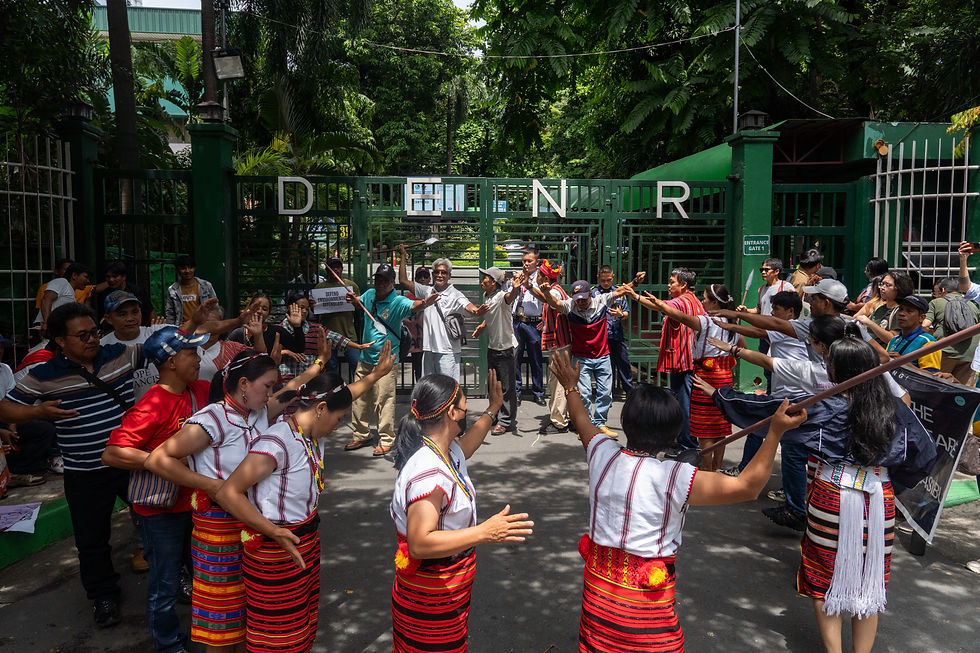
After the forum, CPDG and Defend NGOs Alliance trooped to the Manila Regional Trial Court Branch 28 in order to stand in solidarity with LCDE Executive Director Jazmin “Minet” Jerusalem’s impending civil forfeiture case that was filed by Anti-Money Laundering Council on February 19, 2026.
Ms. Jerusalem was targeted by a civil forfeiture order that attempts to confiscate personal and organizational bank accounts. This relates to the ongoing terrorism financing charges that are levied against her. With almost 4 decades of humanitarian and development work experience, the charges faced by Ms. Jerusalem are a manifestation of the broad campaign of repression against NGOs and development workers.
After much public pushback from civil society, the National Union of People’s Lawyers (NUPL) recently announced that the court lifted the Provisional Asset Preservational Order (PAPO) and denied the government’s request for an Asset Preservation Order (APO) relating to the civil forfeiture case of LCDE.
According to the order issued by the Regional Trial Court of Manila, Branch 28 the measures to freeze assets can not be done under the pretense of unsupported allegations and must be grounded on competent evidence. The petition states that there was a failure to link the bank accounts and transactions to the unlawful activity under the Anti-Money Laundering Act (AMLA) and the Terrorism Financing Prevention and Suppression Act (TFPSA).
The Climate Change Network for Community-based Initiatives (CCNCI) welcomes the decision of the court and hopes that the case of LCDE may set a precedent for all impending cases against humanitarian and development work organizations.
Furthermore, CCNCI stands in solidarity with our fellow civil society organizations that fill the immense vacuum of basic social services left by widespread government neglect. Five years into the ratification of the ATA its residual effects remain pervasive across organizations that amplify the voices of the marginalized sector.
We emphasize that our existence and role to fill institutional vacuums must be supplemented by a genuine desire to organize and achieve meaningful societal change because while we are in service to the people, our capacity is limited. Our existence must not legitimize societal dysfunctions but rather bolster the call as first-responders of state neglect in the achievement of a more just world.


Comments