


RESIDENTS OF BRGY. 105 AND 128 AGAINST WASTE-TO-ENERGY PROJECT
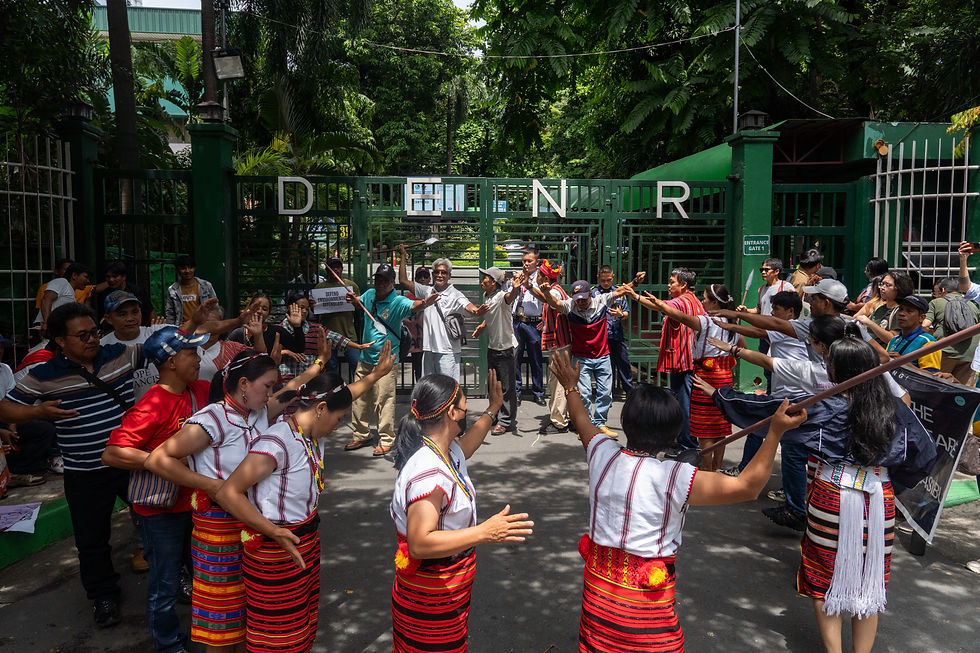
Residents of Brgy. 105 and 128, Tondo, Manila staged an indignation protest in front of the barangay hall in order to assert their right to life and livelihood amidst the on-going displacement of families in Upper Smokey Mountain in order to make way for a P26 billion Waste-to-Energy (WTE) facility project under the Manila Integrated Environment Corporation (MIEC) which is a company owned by businessman Reghis Romero who also owns R-II Builders.
Residents stated that they faced intimidation and coercion at the hands of R-II Builders who pressured them to accept a compensation of P60,000 for their displacement. Samahan ng Magkakapitbahay sa Upper Smokey Mountain (SMUSM) - Kadamay Vice President Anora Madrid emphasized the ongoing conflict between the local government officials and the affected residents.
She questioned the rude remarks of local barangay officials who refused to help the residents of Brgy. 105 in their vocal opposition against the impending project. For the meantime, she states, the construction of the project displaces the residents of Brgy. 105; however, she emphasized that its creation will lead to long-lasting health and environmental effects.
She further states that amidst the extreme poverty within the local communities of Tondo, Manila that the decision of the government to construct the aforementioned project instead of alleviating the immediate poverty in the communities they serve shows their skewed priorities. With social, economic, and health services severely lacking in the affected barangays, she criticized the decision of the local government instead of providing ample support for the livelihoods of their residents.
Simultaneously, a dialogue was also held between the local government officials and Rep. Renee Co of Kabataan Partylist during her courtesy visit to the barangay. In their dialogue, she stated that the barangay officials committed to stop the demolition should the residents be opposed to it and explained that the ongoing displacement of residents is caused by the coercion and intimidation of R-II Builders.
She added that the barangay officials committed to engaging in a dialogue with residents and representatives in order to address these ongoing cases with the local office clarifying that the demolition is solely undertaken by the corporate entity and not them. Furthermore, she emphasized that the R-II Builders Inc. is complicit in deceiving the residents, as well as barangay officials, on the merits of their project. Rep. Co explained that the corporation was not able to provide a document or a legal basis behind their promises.
The Climate Change Network for Community-based Initiatives stands in solidarity with the affected residents of Brgy. 105 and Brgy. 128 whose public clamor has invigorated the discussion surrounding renewable energy projects at the expense of local residents. As an institution dedicated to researching climate solutions, it is important to highlight that even the affected residents are not opposed to renewable energy projects.
Ideally, those that stand to gain the most from renewable energy projects are the most vulnerable sectors in our country. In fact, Tondo Manila hosts a great concentration of the most impoverished in the Philippines with a severe lack of access to basic necessities such as electricity, waste-disposal, and water. Lessening cost merits better access and reach to those who can not afford it previously.
However, large-scale garbage collection contractors such as Philippine Ecology Systems Corporation (PHILECO) tout these benefits without proper consideration for the most vulnerable sectors that are affected by their project.
Foremost, incineration remains illegal under Section 20 of RA 8749 or the Philippine Clean Air Act of 1999 which is responsible for the nationwide ban on incinerators with toxic and poisonous fumes. Incidentally, contrasting these supposed benefits of incinerator projects is the schema of ownership of our most basic services which remains largely privatized.
This entails that while establishing a regulating body can still mitigate the cost of its output, while costs that relate to operational expenses will remain dictated by the private entity. However, these projections point to an even more salient point which is the distinct lack of information and informed prior consent to the affected residents. While not directly complicit, the fact remains that these demolitions slipped under the watchful eyes of the local government.
Listed as a priority project of both the local and national government of President Marcos Jr. and Manila City Mayor Isko Moreno, it cannot be denied that the establishment of these projects received explicit support from government officials across the hierarchical echelons. Therefore, the demand for accountability and transparency grows more fervent as the displacement of residents continues.
Extreme poverty has historically been concentrated in Tondo, Manila with two terms of Isko Moreno’s mayoralty bringing nothing but superficial infrastructure projects and anti-poor programs that trample upon the electoral facade he once fronted during elections.
In the face of the worsening living situation in your hometown, why are you the first to aggressively sponsor its decline?


Comments