


"WHAT LED TO THE ARRESTS OF DDN7?" : A TIMELINE OF STRUGGLE AGAINST WOGGLE CORPORATION'S EXPLORATION ACTIVITIES
Across the globe, the Philippines’ is fourth in terms of its copper ore reserves, holding over 4.41 billion tons of deposits in its land. It also ranks fifth for its nickel reserves with over 5.29 million tons and holding over 4% of the world’s reserves of cobalt with over 286,000 tons of deposits.
Government estimation of rare-earth minerals is valued at over $1 trillion dollars with only 5% of these reserves being actively explored. The mining industry, at present, only accounts for 1% of the total Gross Domestic Product in the Philippines.
Data showed that in 2024, the Philippines exported a total of $7.37 billion worth of ores and minerals to China due to our limited capacity in processing these ores, solidifying our position as one of the major exporters in the industry.
A significant majority of these mining operations is concentrated in Nueva Vizcaya where its indigenous community reminisce over the environment before the entry of large-scale mining corporations.
Arimco Mining Corporation is one of the first major mining companies to enter the province in the 1990s. Barangay Didipio became their center of operations which resulted in the flattening of Mount Dinkidi’s high peaks in order to create a large-scale open-pit mine.
Didipio mine is 27,000 hectares that borders between Nueva Vizcaya and Quirino which is estimated to hold over 1.41 million ounces of gold and 169,400 tons of copper which is enough to maintain its operations for over 20 years.
Despite vocal opposition from the communities of Nueva Vizcaya, the Financial or Technical Assistance Agreement (FTAA) of OceanaGold Philippines, signed in 1994, expired in June 2019 and was renewed two years later.
A Petition for Certiorari, led by the Roman Catholic Diocese of Bayombong, which sought the reversal of the FTAA that was issued to OceanaGold Philippines, Inc. was at Bayombong Regional Trial Court by Legal Rights and Natural Resources Center (LRC) on behalf of its petitioners.
In its petition, it cited a grave lack of consultation with its communities and a grave abuse of discretionary powers of local government authorities who endorsed its renewal. They cited Section 96 of the 1995 Mining Act which states that a violation of terms and conditions is sufficient grounds for cancellation of a mining corporation’s FTAA.
At present, the case now sits at the Supreme Court (SC) which is impending to review the ruling of Bayombong Regional Trial Court that prior public consultations does not apply in the renewal process of FTAAs but a mere continuation of it.
Should this petition fail to revoke the FTAA of OceanaGold Philippines, Didipio Mines will remain operational until June 19, 2044 under a 60-40 revenue sharing scheme. Despite the immense wealth created by these mines, there is a clear discrepancy between its contribution to the overall GDP of the country and the percentage taken home by foreign countries.
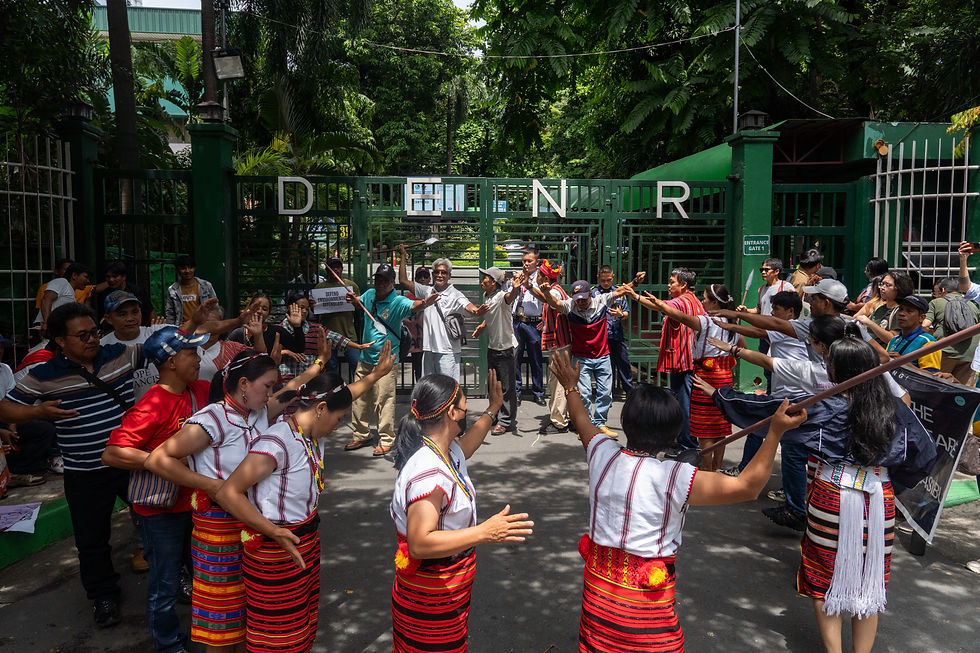
Woggle Corporation is the newest case that exhibits ALL the characteristics embodied by previous mining corporations. CCNCI relays the timeline of its application until its violent entry into Brgy. Bitnong, Sitio Keon.
The process of corruption, violence, and injustice embedded within the existence of mining operations are not isolated incidents but a pattern of environmental degradation in the name of profit.
CCNCI continues to stand firm in its commitments in rebuking the narrative of “responsible mining” when a great majority of the industries operation is mired by such cases of injustice.
CCNCI will stand in solidarity with civil society’s broad campaign against mining for there is no climate justice when extractive mining remains the root cause for the destruction of the livelihood of our communities.
𝐃𝐀𝐆𝐀, 𝐁𝐈𝐀𝐆, 𝐊𝐈𝐍𝐀𝐁𝐀𝐊𝐍𝐀𝐍𝐆
𝐒𝐀𝐋𝐀𝐊𝐍𝐈𝐁𝐀𝐍!


Comments